REVIEW · OSAKA
Traditional Calligraphy Experience near Dotonbori
Book on Viator →Operated by MIYABI Culture Salon · Bookable on Viator
If you want a calmer side of Osaka, do this. Traditional kanji calligraphy class gives you English guidance from an instructor and ends with a ready-to-go hanging scroll souvenir. One heads-up: it’s only about an hour, so you’ll focus on a small, manageable set of writing rather than a long, multi-character practice session.
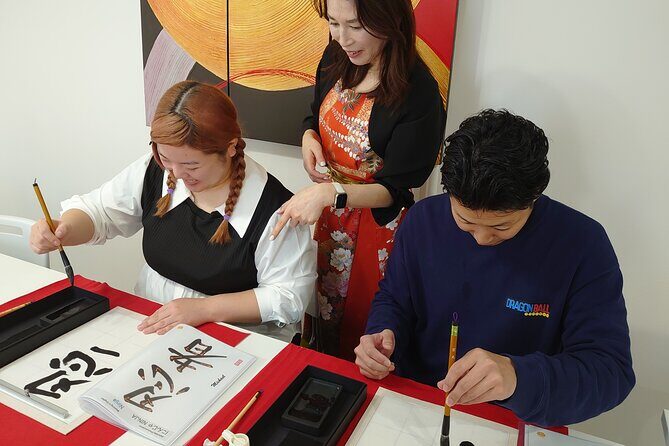
The vibe is part spiritual, part practical. You’ll learn the background of calligraphy, then get hands-on with the tools and correct way to write kanji. Even better, you sit on a chair, so you can concentrate on strokes instead of fighting posture.
This is also small-group learning (up to 8), which matters when you’re new. You’ll choose your favorite kanji from samples and copy what you see, step by step, while your instructor coaches you through the basics. If you’re the type who likes clear instructions and a tangible keepsake, this is a solid match.
In This Review
- Key things to know before you go
- A Short Calligraphy Reset Near Nishishinsaibashi
- Your 1-Hour Flow: History, Tools, and One Ready-to-Frame Scroll
- How the Instructor Helps You Hold the Brush and Stay Comfortable
- Choosing Kanji When You Are a First-Timer
- Practicing Without Pressure: Small Group Advantage (Up to 8)
- What You Take Home and How to Make It Last
- Price and Value for $45.52 in Osaka
- Who This Calligraphy Class Fits Best
- Should You Book This MIYABI Culture Salon Calligraphy Session?
- FAQ
- FAQ
- How long is the calligraphy experience?
- Is the instruction offered in English?
- Do I have to sit on the floor?
- Do I need to know kanji before I come?
- What do I take home at the end?
- Where is the meeting point?
- What group size should I expect?
- How much does it cost?
- Is there a cancellation refund available?
Key things to know before you go
- Small group setting keeps the pace friendly and gives you chances to get questions answered
- Chair-based practice means you can write comfortably while you learn correct brush habits
- Pick-your-own kanji from prepared samples helps first-timers succeed fast
- A full souvenir at the end: kanji on a hanging scroll plus your name and a stamp
- English instruction makes the technique lesson easier to follow
A Short Calligraphy Reset Near Nishishinsaibashi
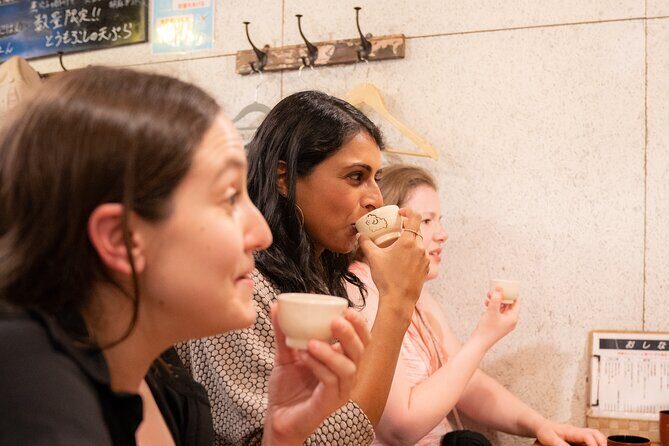
This experience takes place in Osaka’s Chuo Ward, at 1-chōme-5-12 Nishishinsaibashi—an area that’s close to the Dotonbori side of town. That’s a nice pairing: you get real cultural practice without needing to escape the city or plan a complicated detour.
Also, the meeting point is straightforward, and the class ends back where it starts. So you’re not stuck figuring out logistics mid-day, which is a big deal when your itinerary already has shopping, food stops, and city walking.
What I like about this location choice is that it lets you do something quiet and focused while still staying near where you’re already going. If your Osaka day includes Dotonbori anyway, this is the kind of activity that gives your trip a different texture: less neon, more intention.
You can also read our reviews of more tours and experiences in Osaka.



Your 1-Hour Flow: History, Tools, and One Ready-to-Frame Scroll
The session runs about one hour, and it’s paced for beginners. You’re not just handed materials and left to figure it out. Instead, it moves in a clear order that builds from meaning to technique to final keepsake.
Here’s the flow you can expect:
- You start with a short lecture on the background of calligraphy, so you understand what you’re doing and why it matters.
- Next comes learning the traditional tools and the correct way to handle them.
- Then you choose a kanji from instructor-provided samples and try to imitate it.
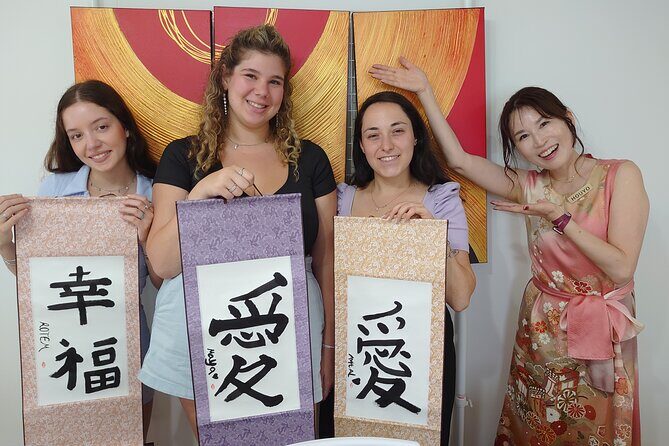
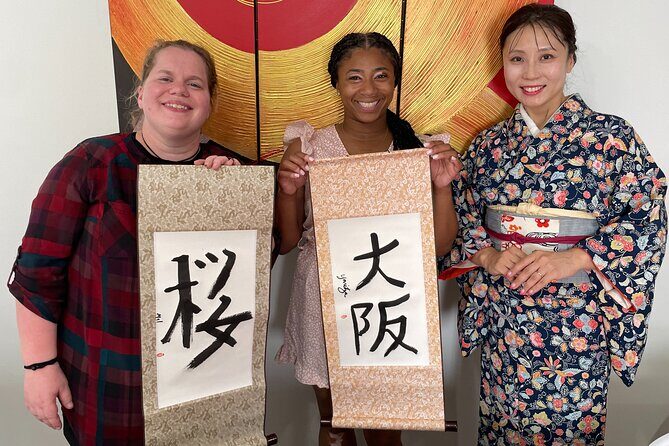
- Finally, you write your chosen kanji on a hanging scroll, add your name, and finish with a stamp.
That order matters. The lesson begins with context before you touch the brush. Then you learn technique in a guided way, and only after that do you produce the final piece you’ll take home. For first-timers, that reduces the typical stress of not knowing what to aim for.
The whole thing is designed around making sure you end with something complete—something you can actually show later. And because you write your name and stamp it, the finished scroll feels personal, not generic.
How the Instructor Helps You Hold the Brush and Stay Comfortable
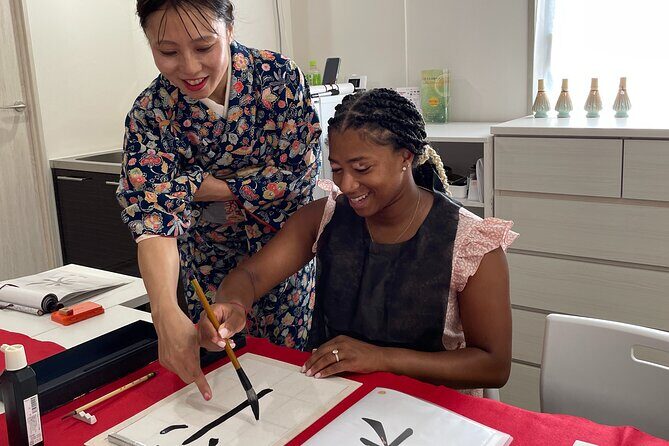
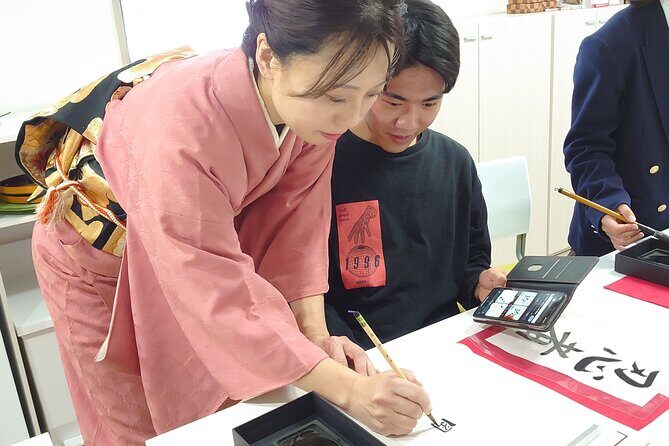
The core of the class is the technique: how to hold the brush and how posture affects your strokes. In the reviews, this part is repeatedly praised, especially the idea that your posture has real impact on how the kanji turns out.
The good news for you is that you don’t have to do awkward standing practice. You can sit on a chair, so your body isn’t the limiting factor. You can focus on control—how the brush moves, how pressure changes, and how each stroke flows.
Instruction is in English, which makes the coaching more useful. Even if calligraphy is totally new to you, the instructor can explain what to do and why, instead of you trying to guess from gestures alone.
If you’re hoping for a patient, encouraging teacher, the reviews highlight exactly that kind of support. One instructor name that comes up in feedback is Fumi, and her teaching style is described as patient and goal-focused—she wants you to succeed, not just watch you struggle.
Choosing Kanji When You Are a First-Timer
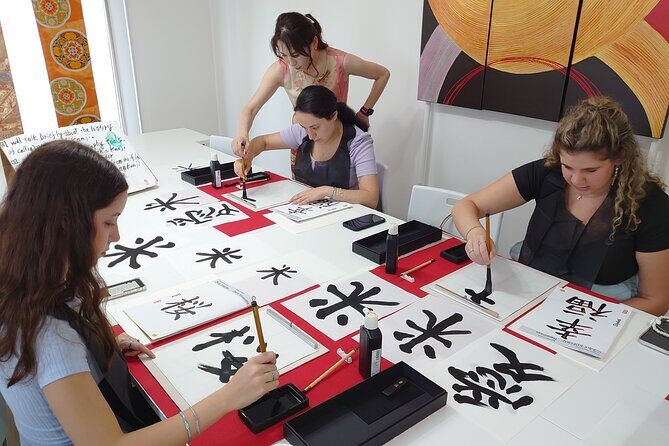
One of the smartest parts of this class is that you’re not forced into learning the “hard stuff” immediately. You pick your favorite kanji from samples the instructor prepares, and you practice by imitating them.
That approach does two helpful things for you:
- It gives you a target to copy, so you’re not reinventing the form.
- It keeps motivation high because the character has meaning for you personally.
The lesson is also built to help your mind settle. Calligraphy is described as a traditional way passed down over time, and the act of writing kanji on white paper is framed as calming and clarifying. You can feel how the focus gets tighter as you practice—your movements get more unified, like your attention clicks into place.
If you’re worried you’ll mess it up, don’t. The point is learning the correct way to write, not producing a perfect museum-quality piece on the first try. By choosing from prepared examples, you’re working within a structure that makes beginner success realistic.
Practicing Without Pressure: Small Group Advantage (Up to 8)
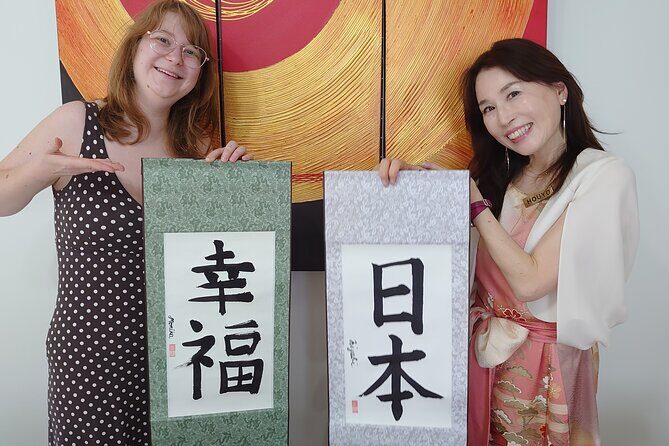
This is capped at a maximum of 8 travelers, which changes the experience. In a group that small, the instructor can notice what you’re doing—especially with something as physical as brush control.
In feedback, a repeated theme is that you can practice as much as you want during the session. That’s important because calligraphy isn’t like a quick photo-op craft. It’s muscle memory plus visual accuracy, and you need a little repetition to get comfortable with how the strokes behave.
The small group also helps if you’re traveling with someone—like a partner or a child. One review mentions a daughter enjoying the class, which fits the overall beginner-friendly design. If you want something educational but not intimidating, this is the style of activity that tends to work well for families.
So if you’re the type who likes “ask, try, fix, try again,” you’ll probably like this setup.





What You Take Home and How to Make It Last
The end result is the part that turns the class into a real keepsake: you write on a beautiful hanging scroll, take it home, and keep it as a memory of Japan.
You don’t just copy one character. You add your name and stamp it to finish. That finishing step matters more than you might expect. The stamp is your mark, and it turns the scroll into something that feels authored by you, not just a sample you purchased.
If you care about presentation, you’ll be glad this is a hanging-scroll format. It’s easy to display and it looks great even if you’re not a calligraphy expert. The class gives you a finished product, not just practice sheets.
Practical tip: treat the finished scroll carefully while you’re traveling. Don’t fold it in your bag. Keep it protected so your effort stays crisp when you arrive home.
Price and Value for $45.52 in Osaka
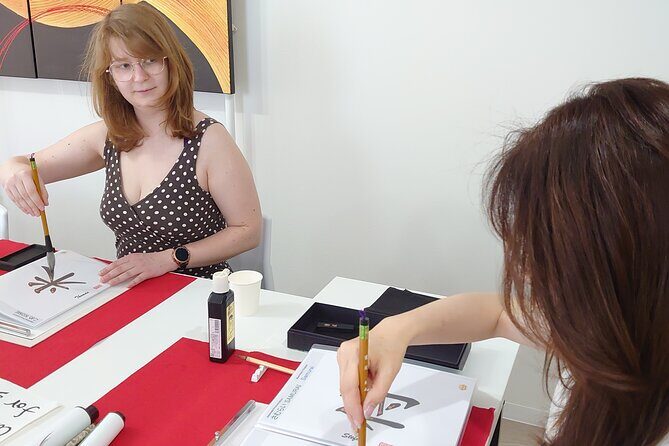
The price is $45.52 per person for about 1 hour of instruction, and you’re not just paying for time. You’re paying for guided teaching in English, correct tool technique, and a take-home hanging scroll that becomes your final project.
Here’s where the value shows up for you:
- You get professional coaching on how to write kanji, not just general “try this brush” guidance.
- The class stays small, so your learning doesn’t get diluted in a large crowd.
- The souvenir is included in the experience format: your kanji, your name, and your stamp on the scroll.
Could you do calligraphy for less money elsewhere? Maybe, depending on what’s available. But this is paying for an instructor-led experience that outputs something tangible within a short time window. For travelers on a tight schedule, that’s the key value.
Timing also matters. The listing data suggests it’s commonly booked about 23 days in advance on average. That’s a sign it’s not something you should always assume you can grab last minute, especially during busier travel periods.
Who This Calligraphy Class Fits Best
This class is especially good if you want:
- A calmer activity in Osaka that still feels authentic
- Beginner-friendly instruction with English support
- A short, structured session that ends with a real souvenir
- A workshop format where you can sit comfortably instead of standing for long stretches
It also works well if you like the idea of learning one meaningful kanji and refining the basic technique rather than trying to cram in too much.
If you’re traveling with kids, the class can be a good fit. One review specifically calls out a daughter enjoying the experience, which aligns with the “choose your kanji, practice with guidance, take home a finished scroll” approach.
On the other hand, if you’re already advanced in calligraphy and expect a long training plan, you may find the one-hour format limited. This is built for learning the correct fundamentals and producing a finished piece, not for deep study over multiple sessions.
Should You Book This MIYABI Culture Salon Calligraphy Session?
If your goal is to experience a traditional Japanese craft in a way that’s understandable and rewarding, I’d say this is worth booking. The big strengths are the English-led instruction, the patient coaching, and the fact that you leave with a hanging scroll created by you.
Book it if you want a meaningful souvenir you can display at home and if you’d rather learn step by step than freestyle a craft alone. It’s also a good choice when you want something relaxing that still feels “real” and not overly touristy.
Skip it only if you’re chasing a long, intensive training course or if you’re looking to learn multiple new kanji in depth. In that case, you might want a longer workshop format.
If you’re in Osaka and you want a break from the usual sightseeing loop, this is one of those activities that feels worth your time.
FAQ
FAQ
How long is the calligraphy experience?
It lasts about 1 hour.
Is the instruction offered in English?
Yes, instructors teach calligraphy techniques in English.
Do I have to sit on the floor?
No. You can practice while sitting on a chair.
Do I need to know kanji before I come?
No. If you’re new, you can choose a kanji from samples provided by the instructor and imitate it.
What do I take home at the end?
You write your chosen kanji on a hanging scroll, then add your name and a stamp. You can take the hanging scroll home.
Where is the meeting point?
The meeting point is 1-chōme-5-12 Nishishinsaibashi, Chuo Ward, Osaka, 542-0086, Japan.
What group size should I expect?
The class has a maximum of 8 travelers.
How much does it cost?
The price is $45.52 per person.
Is there a cancellation refund available?
Yes. You can cancel for a full refund up to 24 hours in advance, with free cancellation available.