REVIEW · OSAKA
Learning Shodo with a kimono and Trying Samurai Calligraphy
Book on GetYourGuide →Operated by 株式会社武士の誉れ · Bookable on GetYourGuide
A kimono and a calligraphy brush in one hour. The Shodo lesson at Bushi no Homare (Samurai Honor) is a straightforward, photo-friendly way to experience Japanese culture, and I like that you learn how to write your name in kanji instead of just watching. Two big wins for me are the hands-on stroke practice and the fun identity moment of the Samurai Calligraphy character. One potential drawback: the venue can feel a bit close to outside noise, with trains reported nearby, so if you’re sensitive to sound, plan for it.
This is a small-group setup (up to 10) and it’s designed to be friendly even for kids, which is rare for calligraphy. I also like that the teaching includes English support by default, with other languages possible if you ask ahead. If your goal is a silent, museum-like calligraphy atmosphere, this may not be your vibe—but if you want a memorable, guided activity, it’s built for that.
In This Review
- Key highlights worth knowing before you go
- Finding Samurai Honor and getting into kimono mode
- The 60-minute Shodo flow: tools, mindset, stroke order, and your name in kanji
- Step 1: mindset + tools before the brush moves
- Step 2: brush movement and technique you can copy
- Step 3: kanji practice with stroke order
- Step 4: the surprise—your foreign name written in kanji
- Step 5: your final draft (with optional presentation pieces)
- Trying Samurai Calligraphy: one-character meaning, beauty of margins, and the oversized brush
- The setup: one character for resignation
- The aesthetic rule: beauty of blank spaces
- The big moment: oversized brush on a 150cm x 150cm sheet
- Signing and identity: who wrote the last character
- Photo shoot: Yamato Nadeshiko or a brave samurai
- Photos, a teacher-written gift bag, and taking home your work
- Price and value: what $42 covers in Osaka calligraphy culture
- Practical stuff: time, meeting point cues, and what to bring
- Who this is best for (and the age limits to remember)
- Should you book this Shodo and Samurai Calligraphy lesson?
- FAQ
- How long is the experience?
- What is included in the $42 price?
- What language is the interpreter, and can other languages be arranged?
- Can I write my name in kanji?
- What should I bring with me?
- Where is the meeting point?
Key highlights worth knowing before you go
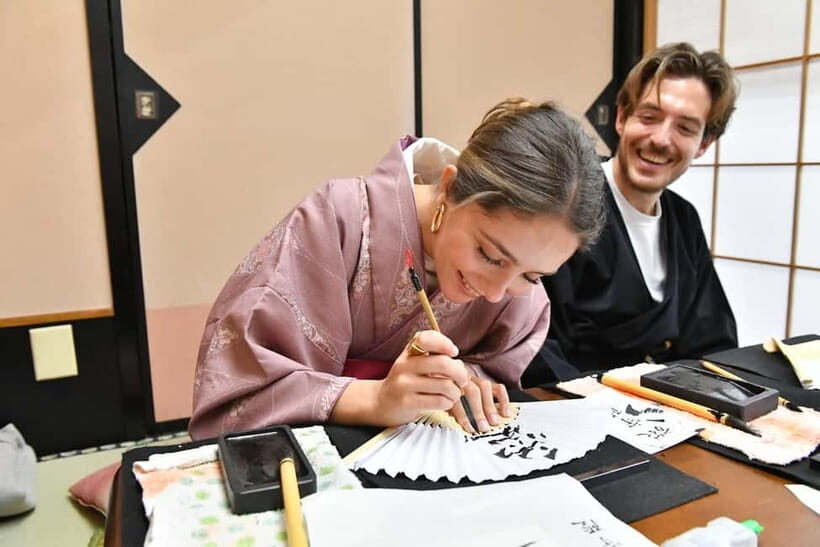
- Wear kimono + get dressed for photos right at the start, so your experience feels like a real transformation, not a quick costume.
- Your name in kanji: you choose kanji first, then the instructor writes your foreign name using those characters and explains what they mean.
- Stroke-order practice: you learn brush technique and the order of strokes, then copy the master’s example.
- Samurai Calligraphy with an oversized brush on a huge 150cm x 150cm sheet, making your final character feel bold and dramatic.
- A finish-and-sign moment: your owner identity is reinforced through signing, plus you take home your work in a special bag.
- Family-friendly by design: the format works with children, with patient instruction that keeps everyone participating.
Finding Samurai Honor and getting into kimono mode
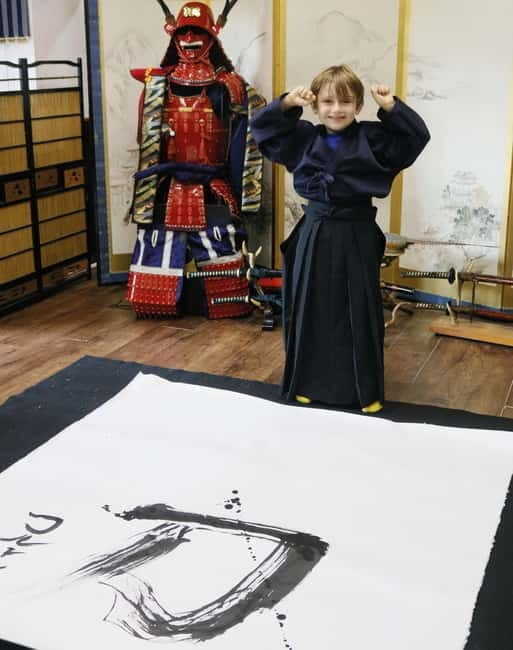
This experience happens at Bushi no Homare (Samurai Honor) in Osaka (Honshu). The lesson takes place at Excellence Takayama, and the venue is easy to miss if you show up late or rely on the wrong map pin. Apple Maps is listed as incorrect, so use the provided Google Maps link and trust that route.
For the meeting point, look for a wooden sign that says Honor of the Samurai. It’s described as a rack in front of the store with activity pamphlets, and there are kimonos and hakama hanging out to dry, which makes the place look busy in a very Japanese way.
Timing matters here. Plan to arrive 30 minutes early for instructions and changing clothes. The activity itself is short—1 hour total—so if you cut it close, you’ll feel rushed when you’re trying to learn brush handling and basic technique.
One more practical note: you only need to bring a t-shirt. That’s your easy base layer under the costume, and it helps keep the process smooth when you’re getting fitted for kimono-style clothing.
You can also read our reviews of more tours and experiences in Osaka.



The 60-minute Shodo flow: tools, mindset, stroke order, and your name in kanji
The Shodo part is where the lesson turns from costume fun into real skill. The overall pacing is built in steps, and each step has a purpose.
Step 1: mindset + tools before the brush moves
Before you pick up the brush, you change into traditional Japanese clothing such as a kimono. That matters more than it sounds. Calligraphy here is treated like an aesthetic practice, not just handwriting. You’ll also get the basics for how to hold the brush and use the tools correctly.
Step 2: brush movement and technique you can copy
Next comes brush technique: how movement affects the final character. You practice how to control strokes so your marks don’t look shaky or uneven. Even if your Japanese is minimal, this part is approachable, because it’s taught through movement and repeated copying.
Step 3: kanji practice with stroke order
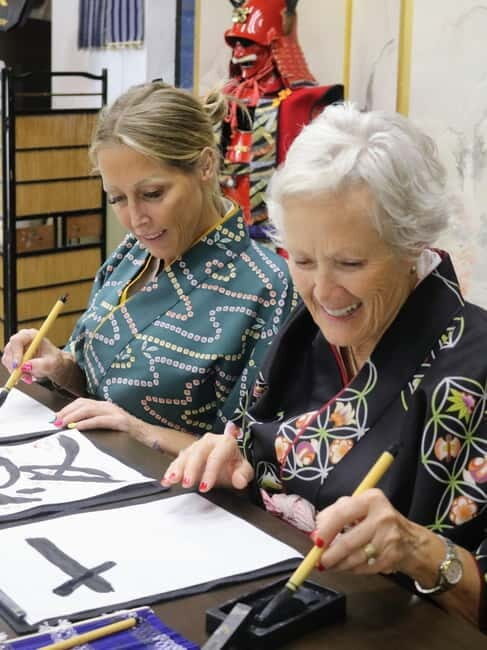
Then you reach the practical heart of Shodo: kanji stroke order. You’ll practice the strokes of the specific characters you selected earlier, using the correct sequence. The instructor demonstrates how to write your kanji using a brush, and you follow along carefully.
If you’ve ever wondered why calligraphy looks so clean, it’s usually stroke order plus brush control. This lesson directly targets both.





Step 4: the surprise—your foreign name written in kanji
Here’s one of the most memorable parts. The teacher writes the foreign names of participants using the kanji characters you’ve chosen. Each kanji character comes with its own meaning, so you don’t just get a random decoration—you learn what the characters are saying and how they relate to your name choice.
This is a great moment for photos too, because you get your personal result in front of you, not just a completed sheet at the end.
Step 5: your final draft (with optional presentation pieces)
Finally, you write a draft that reflects what you learned. You’ll work on calligraphy paper, and there may be extras like a fan and an optional hanging scroll (kakejiku) depending on what you choose. You can take your first calligraphy work home as a souvenir, or frame it and display it if you want to turn it into real décor.
Trying Samurai Calligraphy: one-character meaning, beauty of margins, and the oversized brush
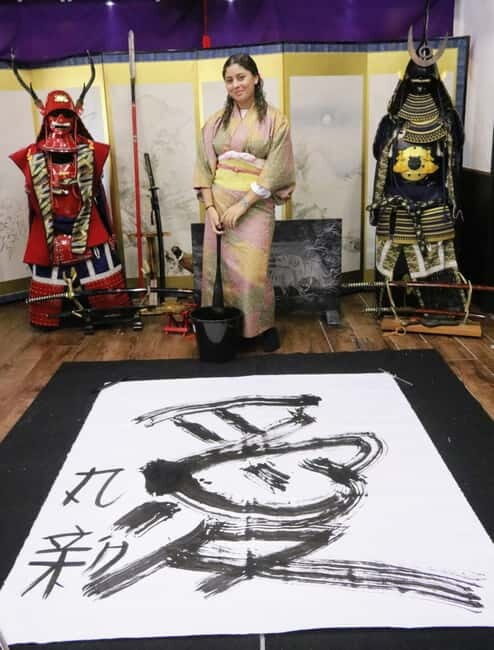
After Shodo comes the Samurai Calligraphy segment, which is shorter at 30 minutes but packed with theatrics and symbolism.
The setup: one character for resignation
You start with a writing prompt that’s emotional without getting heavy. You’re asked to reflect on your life so far and imagine the feelings you want to leave behind. Then you think about the design and composition of your last character in this world. That framing helps you slow down and focus on the character as a single idea, not a bunch of separate lines.
The aesthetic rule: beauty of blank spaces
The Japanese idea of beauty of the margins (blank spaces) gets taught directly. This isn’t a vague arts lesson. It’s a practical reminder that space on the paper matters. A character can look balanced when the empty area is treated as part of the composition.
If you tend to crowd your writing, this is one of the best mental corrections you can get.
The big moment: oversized brush on a 150cm x 150cm sheet
Then you get the signature spectacle: the artist uses an oversized brush—described as more than five times larger than usual—to paint one powerful, fragile, beautiful character on a 150cm x 150cm sheet. Because it’s done with the whole body, not just the wrist, it looks dramatic and physical.
You won’t just watch quietly. You get to see how whole-body movement translates into brush pressure, direction, and stroke character.
Signing and identity: who wrote the last character
After the writing, the artist signs the work so it clearly shows who wrote the last character and identifies the owner. That keeps your experience grounded in authorship, not just watching someone else perform.
Photo shoot: Yamato Nadeshiko or a brave samurai
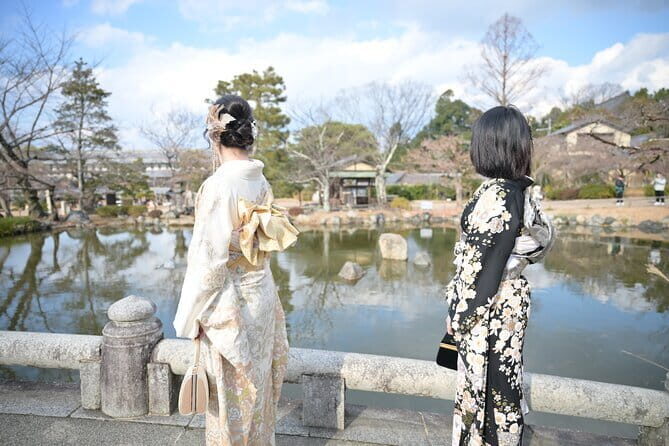
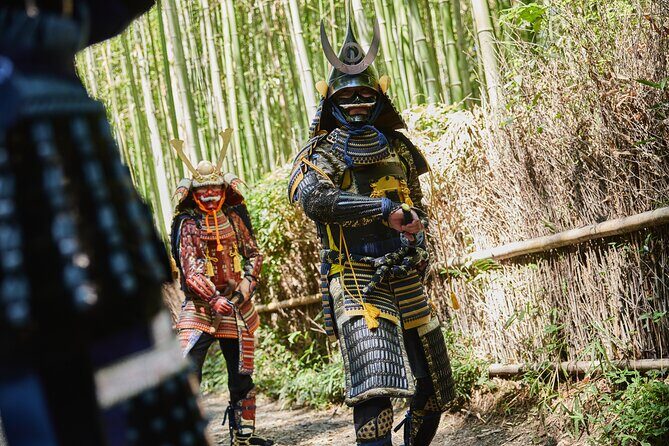
You also get a photo shoot as part of the experience. You’ll be dressed as a Yamato Nadeshiko or a brave samurai, and the goal is to capture both your costume look and your artwork. It’s a fun way to connect the visual side of travel (photos) with the skill you just learned (calligraphy).
Photos, a teacher-written gift bag, and taking home your work
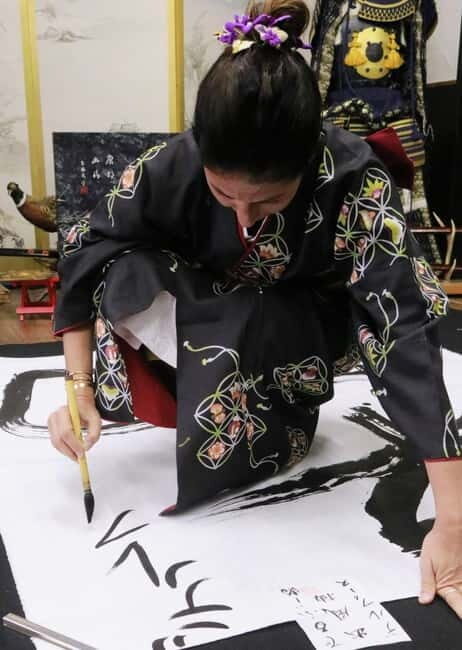
The take-home part is one of the reasons this feels like more than a classroom. You get your calligraphy work, and you also get an extra souvenir that’s tied to the experience.
You’ll receive the photos as digital data sent to a designated email address. That’s convenient because it avoids the common problem of not knowing when your images will show up.
Even better, the teacher carefully writes the kanji character you tried today on the surface of your bag. Then you receive a Samurai Honor original bag as a gift. It’s noted as not available for sale elsewhere, which means it feels like a genuine limited souvenir rather than a generic tote.
If you like “one meaningful thing” over “ten cheap things,” this hits that mark. Your artwork also comes with you, either as a personal memento or something you can display later.
Price and value: what $42 covers in Osaka calligraphy culture
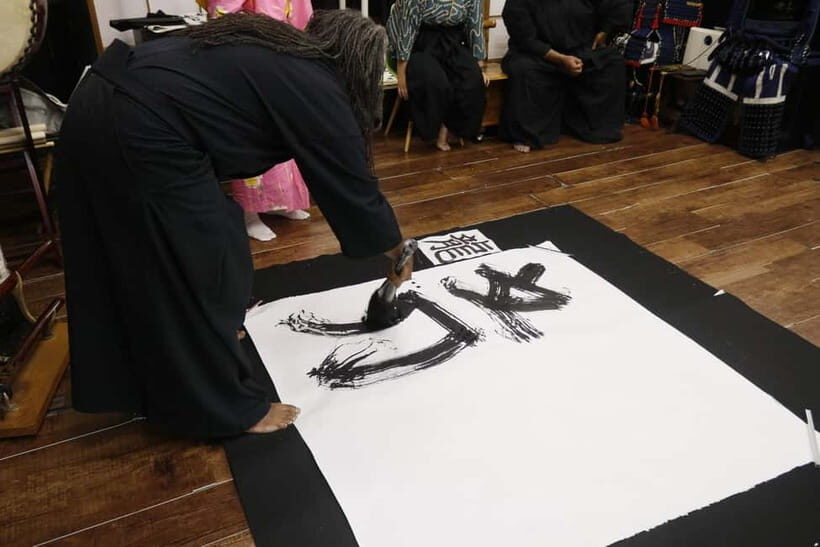
At $42 per person for a total 1 hour, the value is strongest when you want multiple experiences stitched together: kimono time, structured Shodo practice, Samurai Calligraphy storytelling, and photography.
Here’s what’s included:
- Kimono & Samurai costumes
- Certified professional instructor
- Taxes and tips covered
- Photography sent by email
- An interpreter default language of English, plus other languages available on request
And here’s what’s not included:
- Transportation and any station/hotel transfers
- Personal expenses
- Optional add-ons like kakejiku or style packages
- Extra hairset and some full women’s attire items (depending on what you choose)
So the real question isn’t just the price—it’s whether you value guided instruction plus a personal result. If you’re the kind of traveler who likes to leave with a tangible artifact (your kanji sheet and a signed-style item), this price makes sense. If you only want to pose in a costume with no interest in the writing part, it may feel too structured.
This is also capped at 10 participants, which helps keep the experience from turning into a conveyor belt.
Practical stuff: time, meeting point cues, and what to bring
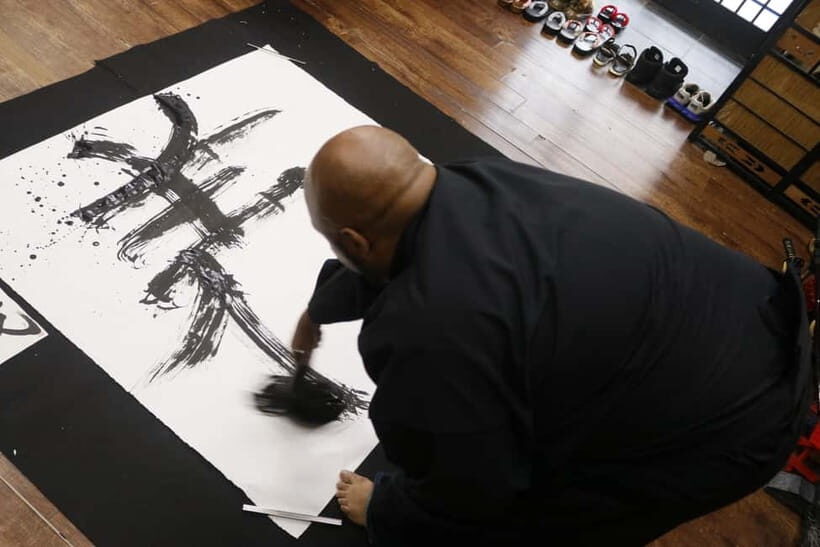
You’ll want to show up prepared because the experience is tight on time.
- Arrive 30 minutes early for changing clothes and instructions.
- Bring a t-shirt (that’s listed as what to bring).
- The interpreter language is English by default. Other languages (Italian, French, Chinese, Thai, Indonesian, Spanish) may be available, but you should ask in advance because staff can be limited.
- The meeting landmark is the wooden rack sign reading Honor of the Samurai, with pamphlets out front and kimono/hakama hanging around.
Dress comfort matters too. You’ll be in kimono-style clothing, so avoid anything you can’t move in comfortably once you’re fitted.
Also check the rules: pets aren’t allowed, baby strollers aren’t allowed, baby carriages aren’t allowed, and there’s no alcohol or drugs. Nudity isn’t allowed either. None of that is surprising, but it helps you pack and plan like a responsible adult.
One more thing: the lesson notes wheelchair accessibility, and the experience has a small-group format. That said, it’s not listed as suitable for everyone age-wise.
Who this is best for (and the age limits to remember)
This experience is designed to be shared. Calligraphy works well for family time because even kids can participate and produce a finished character.
The notes say it’s not suitable for children under 5. The experience also isn’t suitable for babies under 1 year and people over 95. If you’re traveling with kids, it’s a strong option because the format includes hands-on practice and patient support.
If you’re the kind of traveler who enjoys taking home something personal—like your own kanji name work and a bag with the written character—this makes sense.
If your main priority is quiet, gallery-level calm, go in with eyes open. One past experience described the venue as a bit run-down and noted train noise near the door. The instructor experience and the calligraphy teaching can still be great, but the setting might not feel like a private studio.
Should you book this Shodo and Samurai Calligraphy lesson?
Book it if you want a short, guided cultural activity in Osaka that ends with real outputs: your own calligraphy, photos, and a teacher-made souvenir bag. It’s especially worth it if you’re traveling with kids or you like activities where learning is part of the fun.
Think twice if:
- you’re very sensitive to outside noise,
- you only want photos and don’t care about stroke practice,
- or you’re traveling outside the listed age suitability.
If you’re okay with a friendly, hands-on lesson environment, this is one of those 1-hour experiences that gives you something you can actually keep—plus a story that feels distinctly Japanese.
FAQ
How long is the experience?
The total experience is 1 hour, split into 60 minutes of Shodo and 30 minutes of Samurai Calligraphy.
What is included in the $42 price?
Included are kimono & samurai costumes, a certified professional instructor, taxes and tips, and photography (sent to your email). You also have interpreter support in English by default.
What language is the interpreter, and can other languages be arranged?
The interpreter’s default language is English. Other languages may be available (Italian, Spanish, French, Chinese, Thai, Indonesian), but you should inquire about staff availability before booking.
Can I write my name in kanji?
Yes. You select kanji characters earlier, and then the teacher writes your foreign name using the kanji chosen. You’ll also learn the meaning of those kanji characters.
What should I bring with me?
You just need to bring a t-shirt.
Where is the meeting point?
Meet at Bushi no Homare (Samurai Honor). Look for a wooden sign rack that reads Honor of the Samurai, with activity pamphlets in front of the store. Arrive 30 minutes before your reserved time for instructions and changing clothes.